
SBN Network Architecture - Microsoft SQL Server
An overview of SBN Network Architecture when running Microsoft SQL Server. This covers Concentrators, Services, the Database Servers and SBN Clients
SBN Network Architecture for a Microsoft SQL Server installation, with Windows VLan failover setup.
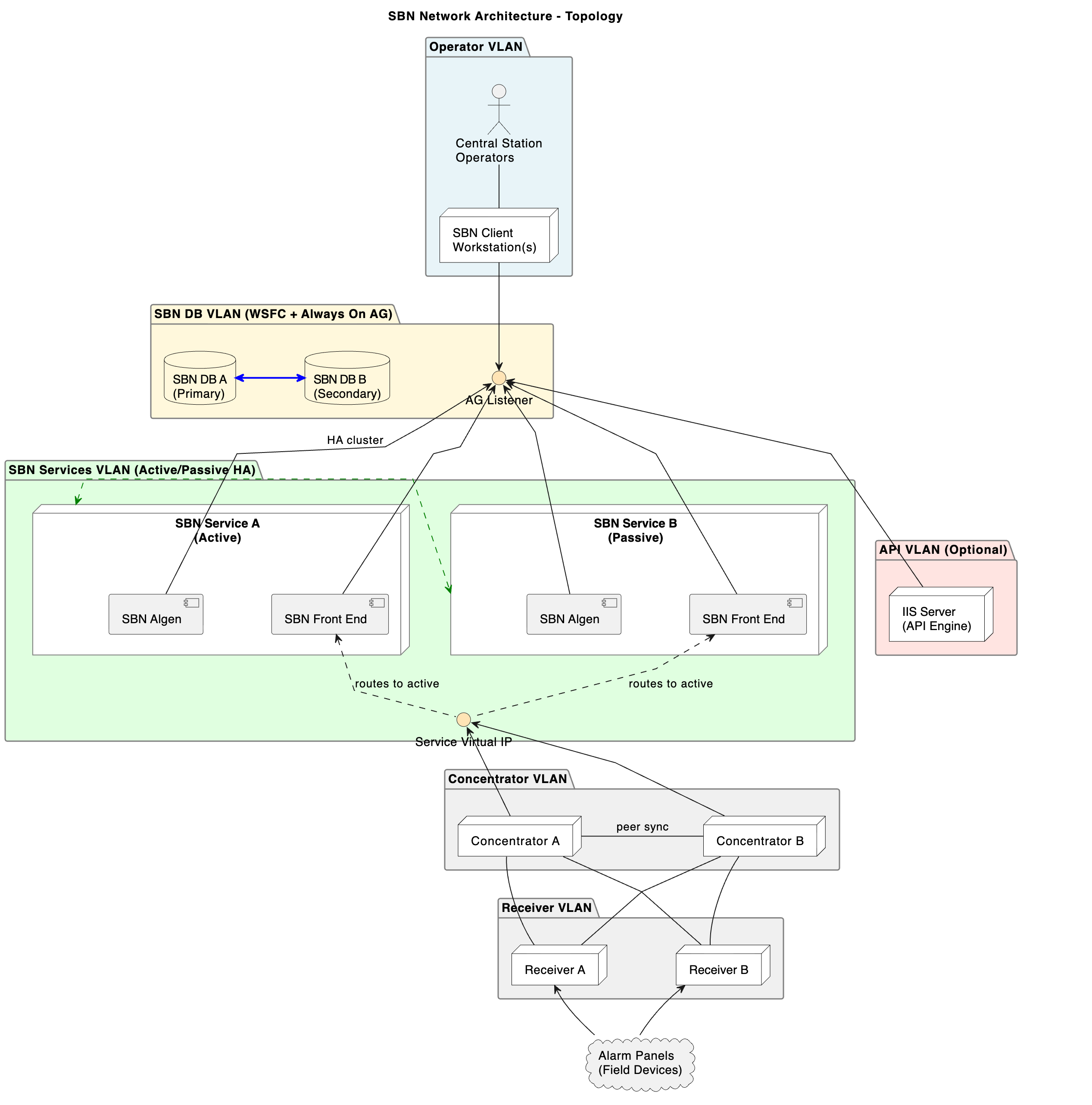
Network Tiers
- Operator (Operator VLAN) — Operator workstations / clients.
- SBN Services (SBN Services VLAN, A/P HA) — SBN Service A (active) + SBN Service B (passive). Two services are shown. There are multiple services running.
- API (API VLAN, optional) — IIS Server hosting the SBN API Engine. Sits alongside the Services tier and talks to SBN DB via the AG Listener. API Engine can run as multiple stateless servers.
- SBN DB (SBN DB VLAN, WSFC) — SBN DB A (primary), SBN DB B (secondary), AG Listener.
- Concentrator (Concentrator VLAN) — Concentrator A, Concentrator B.
- Receiver (Receiver VLAN) — Receiver A, Receiver B.
- Field (External) — Alarm panels.
Approximate Server Sizing - Depending on workload
- Database - 8 Gb Memory, 4 Core CPU, 250 GB Storage
- Services - 4 Gb Memory, 2 Core CPU, 150 Gb Storage
- Concentrator - 2 GB Memory, 1 Core CPU, 100 Gb Storage
- API Engine - 4 Gb Memory, 1 Core CPU, 100 Gb Storage
Port configuration
- Clients -> AG Listener — TCP/
<sql-port>(typically 1433). Clients connect directly to SQL via the AG Listener; resolves to current primary. - SBN Service -> Service (HA) — TCP+UDP/
<wsfc-port>(typilcally 3343). HA heartbeat between Service A and Service B. - SBN Algen -> AG Listener — TCP/
<sql-port>(typilcally 1433). Algen reads/writes SBN DB via AG Listener (both A and B service hosts). - SBN Front End -> AG Listener — TCP/
<sql-port>(typilcally 1433). Front End also reads/writes SBN DB via AG Listener (both A and B service hosts). - IIS API Engine -> AG Listener (optional) — TCP/
<sql-port>(typilcally 1433). Optional API VLAN; IIS server connects to SBN DB via AG Listener. - SBN DB A -> SBN DB B (AG endpoint) — TCP/
<ag-endpoint-port>(typilcally 5022). Always On database mirroring endpoint, sync commit. - SBN DB A -> SBN DB B (WSFC) — TCP+UDP/
<wsfc-port>(typilcally 3343). Cluster heartbeat / intra-cluster comms. - Concentrators -> Service Virtual IP — TCP/
<front-end-port-A>and TCP/<front-end-port-B>(typically 10001, 10101). Each concentrator opens two connections to the Service Virtual IP — one per Front End port. Both target the same active Front End; the two ports separate the A/B signal paths end-to-end. Procedure: SBN Services Cluster Connection Point. - Service Virtual IP -> SBN Front End — TCP/
<front-end-port-A>, TCP/<front-end-port-B>. Internal Virtual IP redirect of both ports to Front End on currently active Service machine. - Concentrator <-> Concentrator — TCP/
<peer-port>. (typilcally 5024) Peer synchronisation. - Concentrators -> Receivers — TCP/
<rx-port>(port dependent on receiver). Cross-connected, both concentrators to both receivers. Concentrator can act both as TCP / UDP listener or servrr - Panels -> Receivers — TCP/
<port>(port dependent on receiver), POTS, cellular. Protocol varies by panel (Contact ID, SIA, IP receiver protocols, etc.).
Was this helpful?